The following is some copyrighted information that can be found at
http://www.learningplaceonline.com/stages/organize/Erikson.htm
It provides some good background information that helps explain some of my attitudes about Reinhardt.
The Developmental Stages of Erik Erikson
By Arlene F. Harder, MA, MFT
"It is human to have a long childhood; it is civilized to have an even longer childhood. Long childhood makes a technical and mental virtuoso out of man, but it also leaves a life-long residue of emotional immaturity in him."
— Erik Homburger Erikson (1902-1994)
Our personality traits come in opposites. We think of ourselves as optimistic or pessimistic, independent or dependent, emotional or unemotional, adventurous or cautious, leader or follower, aggressive or passive. Many of these are inborn temperament traits, but other characteristics, such as feeling either competent or inferior, appear to be learned, based on the challenges and support we receive in growing up.
The man who did a great deal to explore this concept is Erik Erikson. Although he was influenced by Freud, he believed that the ego exists from birth and that behavior is not totally defensive. Based in part on his study of Sioux Indians on a reservation, Erikson became aware of the massive influence of culture on behavior and placed more emphasis on the external world, such as depression and wars. He felt the course of development is determined by the interaction of the body (genetic biological programming), mind (psychological), and cultural (ethos) influences.
He organized life into eight stages that extend from birth to death (many developmental theories only cover childhood). Since adulthood covers a span of many years, Erikson divided the stages of adulthood into the experiences of young adults, middle aged adults and older adults. While the actual ages may vary considerably from one stage to another, the ages seem to be appropriate for the majority of people.
Erikson's basic philosophy might be said to rest on two major themes: (1) the world gets bigger as we go along and (2) failure is cumulative. While the first point is fairly obvious, we might take exception to the last. True, in many cases an individual who has to deal with horrendous circumstances as a child may be unable to negotiate later stages as easily as someone who didn't have as many challenges early on. For example, we know that orphans who weren't held or stroked as infants have an extremely hard time connecting with others when they become adults and have even died from lack of human contact.
However, there's always the chance that somewhere along the way the strength of the human spirit can be ignited and deficits overcome. Therefore, to give you an idea of another developmental concept, be sure to see Stages of Growth for Children and Adults, based on Pamela Levine's work. She saw development as a spiraling cycle rather than as stages through which we pass, never to visit again.
As you read through the following eight stages with their sets of opposites, notice which strengths you identify with most and those you need to work on some more.
1. Infancy: Birth to 18 Months
Ego Development Outcome: Trust vs. Mistrust
Basic strength: Drive and Hope
Erikson also referred to infancy as the Oral Sensory Stage (as anyone might who watches a baby put everything in her mouth) where the major emphasis is on the mother's positive and loving care for the child, with a big emphasis on visual contact and touch. If we pass successfully through this period of life, we will learn to trust that life is basically okay and have basic confidence in the future. If we fail to experience trust and are constantly frustrated because our needs are not met, we may end up with a deep-seated feeling of worthlessness and a mistrust of the world in general.
Incidentally, many studies of suicides and suicide attempts point to the importance of the early years in developing the basic belief that the world is trustworthy and that every individual has a right to be here.
Not surprisingly, the most significant relationship is with the maternal parent, or whoever is our most significant and constant caregiver.
2. Early Childhood: 18 Months to 3 Years
Ego Development Outcome: Autonomy vs. Shame
Basic Strengths: Self-control, Courage, and Will
During this stage we learn to master skills for ourselves. Not only do we learn to walk, talk and feed ourselves, we are learning finer motor development as well as the much appreciated toilet training. Here we have the opportunity to build self-esteem and autonomy as we gain more control over our bodies and acquire new skills, learning right from wrong. And one of our skills during the "Terrible Two's" is our ability to use the powerful word "NO!" It may be pain for parents, but it develops important skills of the will. (See Use of the Will from He Hit Me Back First!)
It is also during this stage, however, that we can be very vulnerable. If we're shamed in the process of toilet training or in learning other important skills, we may feel great shame and doubt of our capabilities and suffer low self-esteem as a result.
The most significant relationships are with parents.
3. Play Age: 3 to 5 Years
Ego Development Outcome: Initiative vs. Guilt
Basic Strength: Purpose
During this period we experience a desire to copy the adults around us and take initiative in creating play situations. We make up stories with Barbie's and Ken's, toy phones and miniature cars, playing out roles in a trial universe, experimenting with the blueprint for what we believe it means to be an adult. We also begin to use that wonderful word for exploring the world—"WHY?"
While Erikson was influenced by Freud, he downplays biological sexuality in favor of the psychosocial features of conflict between child and parents. Nevertheless, he said that at this stage we usually become involved in the classic "Oedipal struggle" and resolve this struggle through "social role identification." If we're frustrated over natural desires and goals, we may easily experience guilt.
The most significant relationship is with the basic family.
4. School Age: 6 to 12 Years
Ego Development Outcome: Industry vs. Inferiority
Basic Strengths: Method and Competence
During this stage, often called the Latency, we are capable of learning, creating and accomplishing numerous new skills and knowledge, thus developing a sense of industry. This is also a very social stage of development and if we experience unresolved feelings of inadequacy and inferiority among our peers, we can have serious problems in terms of competence and self-esteem.
As the world expands a bit, our most significant relationship is with the school and neighborhood. Parents are no longer the complete authorities they once were, although they are still important.
5. Adolescence: 12 to 18 Years
Ego Development Outcome: Identity vs. Role Confusion
Basic Strengths: Devotion and Fidelity
Up to this stage, according to Erikson, development mostly depends upon what is done to us. From here on out, development depends primarily upon what we do. And while adolescence is a stage at which we are neither a child nor an adult, life is definitely getting more complex as we attempt to find our own identity, struggle with social interactions, and grapple with moral issues.
Our task is to discover who we are as individuals separate from our family of origin and as members of a wider society. Unfortunately for those around us, in this process many of us go into a period of withdrawing from responsibilities, which Erikson called a "moratorium." And if we are unsuccessful in navigating this stage, we will experience role confusion and upheaval.
A significant task for us is to establish a philosophy of life and in this process we tend to think in terms of ideals, which are conflict free, rather than reality, which is not. The problem is that we don't have much experience and find it easy to substitute ideals for experience. However, we can also develop strong devotion to friends and causes.
It is no surprise that our most significant relationships are with peer groups.
6. Young adulthood: 18 to 35
Ego Development Outcome: Intimacy and Solidarity vs. Isolation
Basic Strengths: Affiliation and Love
In the initial stage of being an adult we seek one or more companions and love. As we try to find mutually satisfying relationships, primarily through marriage and friends, we generally also begin to start a family, though this age has been pushed back for many couples who today don't start their families until their late thirties. If negotiating this stage is successful, we can experience intimacy on a deep level.
If we're not successful, isolation and distance from others may occur. And when we don't find it easy to create satisfying relationships, our world can begin to shrink as, in defense, we can feel superior to others.
Our significant relationships are with marital partners and friends.
7. Middle Adulthood: 35 to 55 or 65
Ego Development Outcome: Generativity vs. Self absorption or Stagnation
Basic Strengths: Production and Care
Now work is most crucial. Erikson observed that middle-age is when we tend to be occupied with creative and meaningful work and with issues surrounding our family. Also, middle adulthood is when we can expect to "be in charge," the role we've longer envied.
The significant task is to perpetuate culture and transmit values of the culture through the family (taming the kids) and working to establish a stable environment. Strength comes through care of others and production of something that contributes to the betterment of society, which Erikson calls generativity, so when we're in this stage we often fear inactivity and meaninglessness.
As our children leave home, or our relationships or goals change, we may be faced with major life changes—the mid-life crisis—and struggle with finding new meanings and purposes. If we don't get through this stage successfully, we can become self-absorbed and stagnate.
Significant relationships are within the workplace, the community and the family.
8. Late Adulthood: 55 or 65 to Death
Ego Development Outcome: Integrity vs. Despair
Basic Strengths: Wisdom
Erikson felt that much of life is preparing for the middle adulthood stage and the last stage is recovering from it. Perhaps that is because as older adults we can often look back on our lives with happiness and are content, feeling fulfilled with a deep sense that life has meaning and we've made a contribution to life, a feeling Erikson calls integrity. Our strengt h comes from a wisdom that the world is very large and we now have a detached concern for the whole of life, accepting death as the completion of life.
On the other hand, some adults may reach this stage and despair at their experiences and perceived failures. They may fear death as they struggle to find a purpose to their lives, wondering "Was the trip worth it?" Alternatively, they may feel they have all the answers (not unlike going back to adolescence) and end with a strong dogmatism that only their view has been correct.
The significant relationship is with all of mankind—"my-kind."
© Copyright 2002, Arlene F. Harder, MA, MFT
Saturday, May 26, 2007

What did Janie look like?
 This is a very crude likeness. I think she may have had bedroom eyes like this lady, but they were much more intelligent. Whenever you looked into Janie's face, you knew that she knew where she was going and what she was doing.
She was the crown jewel of Reinhardt. But Reinhardt had a dark side, which I will discuss in my next blog.
The deaths of Mr. Barham, John F. Kennedy and Dana Lair
I was fortunate to get through childhood without countenancing death except on a few occasions.
Mr. Barham was my elementary school principal and his death (was it during the sixth grade?) was a shock to all the children. The teachers and PTA moms, as always, did their best to counsel us on the proper way to deal with such a loss. School was let out for the funeral, and as always, Kenny’s mom was my driver. She provided sweet, wise counsel to us children, that at a funeral we may feel like crying because we’re reminded of others that have died and whom we miss. I’ve had several reports in recent emails of the funeral. Here’s Serena’s:
Remember when Mr Barham died?? We all went to the funeral. I had never been to one and was scared to death. They made us sing " Faith of Our Fathers" during the funeral. I still remember his sons at the church.
And it seems like Steve W. said it was an open casket funeral, which must have been a shocker. I don’t remember if Mrs. Williams thought to encourage her little group to walk up front.
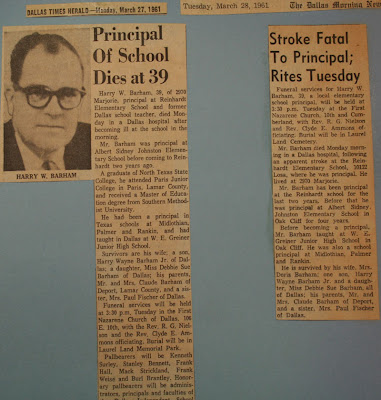
Clipping from Reinhardt Library. June 11, 2007.
We were at the center of the world on November 22, 1963. I think I was in my eighth grade geometry class. Our teachers did the best they could, filled with grief as they were. Kenny, who had a wonderful mom, on that day was more influenced by his Republican firebrand dad. When the teacher left the room to find another adult to hug and cry with, Kenny walked to the blackboard and drew a “hangman” game drawing. It seemed to a be sort of John Bircher’s comment that Kennedy got what he deserved, but I may be misinterpreting and will leave it to him to decided if it was one of his mea culpas.
When I was in the tenth grade, I had a wonderful English teacher Sue Braden. One week, everyone was required to compose a poem and then read it to the class. Here’s mine:
Dallas, once a city of love and wonder.
Now, Dallas, a city of hate.
You see, Kennedy was shot here.
When I finished reading the poem in class, Mrs. Braden said, “Don, you are so cynical.” This was really a very insightful comment and I’m glad she made it.
Dana was with many of us in the Reinhardt classrooms. I remember in the sixth grade sitting with him each day in homeroom in a small cluster of boys. During my adult worklife, I’ve pretty much kept my nose to the grindstone and not spent much time in water fountain banter, but it seems like in the endless hours of classroom sitting, we children had to find ways to amuse ourselves. One day, I was leading my nearby group in how we could use our faces to do something odd and funny. My trick was to snap my tongue, which I could do with an amplitude that matched Janie Wilson’s finger snap. Dana’s trick was to suck his jowls into his mouth, pucker his lips, and move them up and down like a fish. He also may have been able to keep his nostrils sucked together, which added to the effect. We all agreed his was the funniest.
Dana’s father was a physician. I know because one time my mom took me to him when I had a painful ear infection. Dr. Lair almost killed me by stuffing some type of medical wadding into the ear to clean it. He did not strike me as man who had much sympathy or empathy. In the sixth grade, Dana told us that his family had gone skiing in Colorado, I think during the Christmas break. For the times, going to Colorado skiing was a significant differentiator of a family’s social class and wealth. I though it odd, but because Mrs. Hardy commended Dana for his trip to the entire class, I began to grasp that going skiing in Colorado was a sophisticated thing to do. The best my parents could do was to take me and my brother to a Galveston beach.
Dana killed himself, I think several weeks after his graduation from BA. I know nothing about the circumstances. I do have great empathy for him because I know the ways BA could be hard on a boy like that.
I don’t really regard BA as having been a place filled with bullies and mistreatment of kids by other kids. It was a place that would allow you, in your adolescent angst over awkwardness and uncertainty, figuratively to shrink into the wall and disappear. It was a mega high school among mega schools, I think the largest in the state in the early 60’s.
Dana (and me too) might have done better in a smaller high school with small classes and much more intensive adult interaction. And of course, those of us who had warm, loving and communicative parents always weathered our storms more successfully. More about how schools then might have done a better job with children with special needs in the next blog, “The Dark Underbelly of Reinhardt.’
Mr. Barham was my elementary school principal and his death (was it during the sixth grade?) was a shock to all the children. The teachers and PTA moms, as always, did their best to counsel us on the proper way to deal with such a loss. School was let out for the funeral, and as always, Kenny’s mom was my driver. She provided sweet, wise counsel to us children, that at a funeral we may feel like crying because we’re reminded of others that have died and whom we miss. I’ve had several reports in recent emails of the funeral. Here’s Serena’s:
Remember when Mr Barham died?? We all went to the funeral. I had never been to one and was scared to death. They made us sing " Faith of Our Fathers" during the funeral. I still remember his sons at the church.
And it seems like Steve W. said it was an open casket funeral, which must have been a shocker. I don’t remember if Mrs. Williams thought to encourage her little group to walk up front.

Clipping from Reinhardt Library. June 11, 2007.
We were at the center of the world on November 22, 1963. I think I was in my eighth grade geometry class. Our teachers did the best they could, filled with grief as they were. Kenny, who had a wonderful mom, on that day was more influenced by his Republican firebrand dad. When the teacher left the room to find another adult to hug and cry with, Kenny walked to the blackboard and drew a “hangman” game drawing. It seemed to a be sort of John Bircher’s comment that Kennedy got what he deserved, but I may be misinterpreting and will leave it to him to decided if it was one of his mea culpas.
When I was in the tenth grade, I had a wonderful English teacher Sue Braden. One week, everyone was required to compose a poem and then read it to the class. Here’s mine:
Dallas, once a city of love and wonder.
Now, Dallas, a city of hate.
You see, Kennedy was shot here.
When I finished reading the poem in class, Mrs. Braden said, “Don, you are so cynical.” This was really a very insightful comment and I’m glad she made it.
Dana was with many of us in the Reinhardt classrooms. I remember in the sixth grade sitting with him each day in homeroom in a small cluster of boys. During my adult worklife, I’ve pretty much kept my nose to the grindstone and not spent much time in water fountain banter, but it seems like in the endless hours of classroom sitting, we children had to find ways to amuse ourselves. One day, I was leading my nearby group in how we could use our faces to do something odd and funny. My trick was to snap my tongue, which I could do with an amplitude that matched Janie Wilson’s finger snap. Dana’s trick was to suck his jowls into his mouth, pucker his lips, and move them up and down like a fish. He also may have been able to keep his nostrils sucked together, which added to the effect. We all agreed his was the funniest.
Dana’s father was a physician. I know because one time my mom took me to him when I had a painful ear infection. Dr. Lair almost killed me by stuffing some type of medical wadding into the ear to clean it. He did not strike me as man who had much sympathy or empathy. In the sixth grade, Dana told us that his family had gone skiing in Colorado, I think during the Christmas break. For the times, going to Colorado skiing was a significant differentiator of a family’s social class and wealth. I though it odd, but because Mrs. Hardy commended Dana for his trip to the entire class, I began to grasp that going skiing in Colorado was a sophisticated thing to do. The best my parents could do was to take me and my brother to a Galveston beach.
Dana killed himself, I think several weeks after his graduation from BA. I know nothing about the circumstances. I do have great empathy for him because I know the ways BA could be hard on a boy like that.
I don’t really regard BA as having been a place filled with bullies and mistreatment of kids by other kids. It was a place that would allow you, in your adolescent angst over awkwardness and uncertainty, figuratively to shrink into the wall and disappear. It was a mega high school among mega schools, I think the largest in the state in the early 60’s.
Dana (and me too) might have done better in a smaller high school with small classes and much more intensive adult interaction. And of course, those of us who had warm, loving and communicative parents always weathered our storms more successfully. More about how schools then might have done a better job with children with special needs in the next blog, “The Dark Underbelly of Reinhardt.’
Friday, May 25, 2007
Mea Culpa, Mea Maxima Culpa
For those of you who did not take three years of Latin like me, meaning my fault, my grievous fault.
I think there were several years during which I was a bully. Most especially, during Mrs. Hardy’s six-grade class, it was my time to be in the sun. If you’ve raised children, you know each goes through various cycles of change and stability. During those times of late childhood sexual latency, some kids shined within their little environment of teacher recognition, for boys athletic ability and whatever else among children provides status.
And with status came a certain arrogance.
When I reviewed the BA Alumni reunion sign-up sheet, I became concerned that I might see someone whom I had bullied and would be ashamed to see. As it was, I knew hardly anyone and don’t think any of my bully objects were in attendance.
To digress for a moment, one of my childhood friends was Kenny Williams. His mother and father, college-educated, created a very structured, guided home life for Kenny, In contrast, my parents were extreme in their permissiveness and lack of emotional guidance. They were sweet people, but unschooled and unprincipled in childrearing; perhaps it was Dr. Spock’s advice that a child should be allowed to follow his inner nature. At any rate, Kenny went to Sunday School, he was in Cub and Boy Scouts, he was on baseball and basketball teams, and his friend Don was carried around by Kenny’s poor Mom for many years to all these structured activities. A pinnacle activity for your boys was Demolay, and Kenny’s Dad, a Mason, put Kenny in and I trailed in too. Kenny’s Mom, active in PTA, was also friends with moms who were anxious about their sons’ social development. She on occasion tried to make a boyhood triad of a boyhood dyad, which really brought out the verbal bully in me.

Mrs. Williams at right wearing white movie star
sunglasses and with Kenny's younger brother.
Photo taken at Reinhardt Library, June 11, 2007.
Kenny’s Dad also was a staunch Republican. When I had a second popularity due to my early acquisition of a driver’s license, I remember a prescient escapade, some of you may have participated, in which we removed 30-40 campaign signs—Goldwater (or was it Nixon) for President—and deposited them on Mr. Williams two story-brick house front lawn.
When my parents first moved to Dallas, they rented a small place on Kilarney Street. Then they moved to a ticky, tacky $14,000 Fox and Jacobs house on Eastwood. Steve lived uptown on San Lorenzo. And Shari lived with the genteel, gentile set in old Casa Linda (that's a little joke that Shari is the source of).
I’m certain that I’m guilty of many other small brutalities, but my dying brain cells don’t bring all to mind. In Mrs. Hardy’s class, there was a smart but unstatused girl, I think her name may have been Maxine, who I was absolutely brutal to among my friends. Her family moved from Dallas and she came back to the class for a short visit. I remember the pain in her face when she saw me pump up my malicious social disdain.
So with the distance of 40 years, I carry some central guilt about my bully acts during several years of my Reinhardt years, but also have a larger understanding that we baby boomers, who grew up in this Southern middle class suburban cow pasture wasteland of ignorance and prejudice, were fortunate to have Reinhardt, which was at times an oasis in a desert for me.
As adults, we cannot fathom or expect to control the mysterious ways children and adolescents form hierarchy and peck on one another. There’s some brain chemistry, brain development and human evolution factors yet to be discovered. But we can hold adults to a higher level of expectation, and my next blog, “The Dark Underbelly of Reinhardt,” will explore some of the ways our teachers, parents and society might have done a better job.
The Beatles Personality Litmus Test

Subject: RE: Reinhardt memories
Author: Don HancockDate: 5/17/2007 2:12 pm
I really don't have much to say about Gaston. I do have a theory about those times, which I call the Beatles personality litmus test. There was a day in the eighth grade during which all the girls could talk about was the Beatles. Each girl had chosen one of the Beatles to be in love with. John and Paul of course were the stars. The girls that chose John over Paul had a rougher edge. Those that chose George were of the level-headed sort who likely later joined the Future Homemakers to learn about babies, budgets and baking. And those who chose Ringo likely and sadly turned out to be social deviants.
Subject: RE: Reinhardt memories
Author: Rebecca (Phillips) McKinneyDate: 5/17/2007 11:35 pm
Well, I favored Paul, and I still turned out to be a social deviant, being self employed and all. I am right this very minute looking over my desk at that wonderful black & white photo of the Beatles, taken in the late 60's I think. They're all facing one direction, and the wind is blowing their longish hair. Paul is peeking out from behind Ringo with that impish little boy face that made him so irresistable to us girls. I look at the picture whenever I need a youth fix. That's why it's right over my desk. Rebecca (Becky Phillips) McKinney
Subject: RE: Reinhardt memories
Author: Don HancockDate: 5/18/2007 1:32 am
Well, so much for my theory. You should be fairly normal. There could be other contributing factors. Could you give us all some more details about your acts of deviancy?
Subject: RE: Reinhardt memories
Author: Beverly (Parson) WhiteDate: 5/18/2007 1:48 am
Hmmmmm...........well, I went to Casa View and Hill, so, maybe that is the difference....I adored George, was never in FH, got a degree in drawing and painting with no secretarial or teaching cert...held office in NOW.....but I do bake bread and love to cook.........does that count?
Subject: RE: Reinhardt memories
Author: Kathy SilbermanDate: 5/18/2007 4:53 am
I have to say as for me, you pegged it. The John lovers, myself included, I think went for the edgier bad boys, which inevitably in life is a bad choice, but when one must listen to one's gut rather than head as is sometimes not really a choice, it's just the way it is. Now Paul, oh sweet Paul, he was the lover and the sweetheart, the proverbial good guy. Yes, as I have aged, I can see the merit in the Paul's. George, I would not thing of so much as the lead in to Future Homemakers so much as the lead in to the life with a guru and one's head in the stars. I never really quite knew what to make of the Ringo followers...but he was a Beatle and they all have to get their due. Thanks for the thoughts. This board continues to be a source of enjoyment. I can hardly wait till the pictures come out in a few days. Kathy
Subject: RE: Reinhardt memories
Author: Don HancockDate: 5/18/2007 12:37 am
Yes, selecting a slob for a first husband is a signal characteristic of a John girl. Rock and roll can distort us but also heal us. My treatment plans usually include immersion in Paul music, though Joni Mitchell and Joan Baez can be substituted.
Reinhardt Memories
Subject: Reinhardt memories
Date: 5/15/2007 11:20 pm
Since the reunion, Steve, Shari and I have been exchanging many emails with memories about going to Reinhardt, Gaston and BA. I thought I would share this one with a larger group.
Larry was a friend of mine, especially in the second or third grade. I visited his home one time; he lived over near the Catholic school, which was out of our district. His mother worked in the school cafeteria, and she likely got permission for his transfer so she could take him with her to work. I saw Larry’s picture in the 1967 annual and I think he was the only boy who had stuck with his crew cut and butch wax; I admire him for that. Some of the dumb girls pestered me to stop wearing my hair like that a year or so earlier.
At Reinhardt, I followed my older brother’s style of having a big waved over front and combed back sides—I’m sure there are better hairdressing terms for that Elvis style. Each August, when our moms surveyed our worn out, too small clothes, they would pack us off for a new set of Lee jeans, a little long but rolled up to allow some growing room, some high top basketball shoes [made of canvas and rubber, not petroleum-made products], or sometimes some Hardys leathers, possibly with taps on the heels.
Larry had an insider’s view of the Reinhardt cafeteria. Those of us who spent seven years there grew to love it. My mother was not a nurturing box lunch maker and most years I bought my lunch everyday. I always had a second and third trip to the hot roll with butter and ice cream counter. My favorite on the weekly menu was a Mexican dish—I think enchilada pie with chips.
In addition to cafeteria workers, we had janitors, who wore dark uniforms and hung out much of the day in a little basement where they had a machine to clean the chalk from the erasers.

Reinhardt janitor room had entrances from right of
stage and also from outside back of auditorium.
We children were organized for other ancillary support duties. One year, I arrived early each day to be on the U.S. and Texas flag raising team. I had learned all about flags because each morning as a class we recited the Pledge of Allegiance and Pledge to the Texas flag.
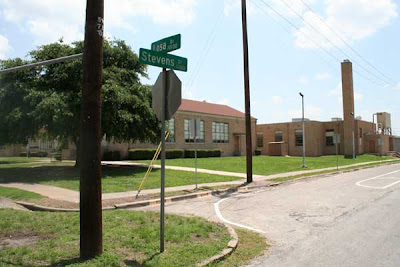
Circa 50s flagpole base at left of telephone pole. Photo
taken June 11, 2007.
Another year I was on the street patrol, and arrived early, rain or shine, and went to some special storage rooms in front of the auditorium where they stored the crossing flags, guard belts, yellow rain coats and galoshes.

Closet at rear of auditorium.
Taken June 11, 2007.
I never knew the Reinhardt physical plant did not include air-conditioning. If you’ve never had something, I guess you don’t miss it. I vaguely remember a special trip to the film room (I believe the only room in the school that was air conditioned and popular with teachers in late spring). Didn’t they have all kids, divided by sex, attend a special film show of sex education? Did we have to get our mother’s permission?
Schools in our Reinhardt era had to have many special facilities. Children are to be cultivated through activities such as gymnastics, dancing, singing, playing the flutophone, and making art. In Mrs. Keeler’s physical education classroom, we had a gym floor with long benches on three walls. Two days a week, Mrs. Keeler played square dance records and we honed our dancing skills—doing allemande lefts and allemande rights. Once a week or so, we had a special activity where the boys from one side of the room were allowed to rush across the room to select their female partner for the dance. And another day, the girls picked the boys... It sort of allowed the carrying out of a natural pecking order of childhood male-female attraction. On two other days a week, the tumbling mats came out, and we practiced our somersault, backward somersault, cartwheel, spiderwalk and flip. When we were bad, for things like breaking a no talking period, we were required to get down on our knees and place our nose on the stinky bench. This was similar to our bomb drill exercises, in case nuclear warheads came flying toward Reinhardt, when we were required to crouch in a fetal position in the hall in front of the lockers with our hands grasped behind our necks.

Circa 1960. Likely 6th or 7th grade class during tornado
drill. From Reinhardt Library. June 11, 2007.
Mrs. Keeler was outdone in my book by Miss Jones, the music teacher. What I would give to have the songbook from the third grade or so—great Southwest songs like Clementine and Celito Linda, and rounds like Dona Nobis Pacem. What were some of the others? And we all tested our musical instrument skills by being required to purchase and learn to play a flutophone.
In the art classes, what was the thin man’s name—Mr. Mattox?, we learned to use crayons, watercolors, tempura paints, did some ceramic work. I was on a team that created a sculptured model of the human eye and also followed the teacher’s instructions to create a three dimensional piece with geometrical placement of string that hung on the wall in front of the principal’s office for several months.
When it came to having a teacher who was in control, Janie Wilson had to take the prize. One snap of her fingers would bring the entire auditorium to total silence. Janie taught us to have school plays, chorus productions, speeches and much other neat stuff. I was honored to be in an evening production, where all the parents came, where a small group of boys, dressed like Elvis, with turtleneck shirts, sang “Watching All the Girls Go By.” All the moms and dads laughed and thought it was cute.
I was in a used bookstore recently and saw a teacher’s resource manual printed by Dallas ISD in the 50s that laid out their marvelous auditorium teaching curriculum. If the school systems could still recruit such cream-or-the-crop women like Janie Wilson, they should bring that back.
We started most days in the gymnasium. When you walked to school like I did, you tended to congregate on the blacktop or inside the gym if it was raining. Before school, with our backs to the wall, we would throw old volleyballs with cuts for handgrips, trying to smash someone at the other end of the gym, to pass the time before the first bell.
Gym classes were run in a very organized fashion. Boys from each class would line up on the floor behind their class captain and co-captain. The girls were lined up on the other side of the gym. Seems like most days we spent some time in calisthenics, Mr. Gerber leading the boys and Miss Moore the girls. We would do sit-ups, arm rolls—boy that really made your arms tired—push ups, leg lifts and other neat exercises.
One of the biggest surprises was a day in the sixth grade or so when Mr. Gerber had all us boys compete in a strength test. One of the activities was to climb the monkey bars. Steve, who had never been a great athlete, was the strongest boy in the class. He was to the top of those monkey bars in an instant. I could only get up to the fourth or fifth bar. So it goes that our childhood bodies distinguished and differentiated us once again.
Each year in the spring, we had the big outdoor field day where each class competed for ribbons—blue for first place, red for second place and gold for third place, in events such as standing broad jump, running broad jump, free throw and hundred yard dash.
If I were ever to go back to Reinhardt for a visit, I would want to go back on Carnival night. The PTA moms put on this big shindig in the fall, I think around Halloween. Each classroom was set up with fun activities like apple bobbing, cakewalk, and darts. They always had a scary room, I think in the art room, where you did scary, nasty thinks like put your hand into a hole and into something nasty like spaghetti. Seems like they also had a big bake sale so we went home with some great cakes and cookies.
We had fun on Valentines Day too. Everyone would make a sack and tape it to the wall. We would all post our Valentines, then read through the cards and messages in our sack. I one year received a very special valentine from Priscilla McClure. I think she must have been sweet on me.
We Reinhardt kids were fortunate to have many intelligent and dedicated men and women teachers and a really fine school system as well as many baby boom cohorts whom we can remember—45 or so years later--with fondness and generosity for each and every one.
Subject: RE: Reinhardt memories
Author: Julie Jenkins BowlingDate: 5/16/2007 1:16 pm
Do you remember the girl in Mr. Maddox room who hurt her leg on the window while cleaning and had to have Mr. Bolton the janitor carry her to the nurses office just before the end of the year? that was me. I remember Mrs. Ripley looked like Olive Oil, but back in thoses days we did not know who Olive Oil was...I remember all the memories you recanted and we lived a much easier time, we just did not realize it at the time. We had all that we needed and wanted at the time. We had more of our parents attention than children of today, times are sooo much more stressful for our kids' kids. Remembering the "good ole days" calms and soothes me. Thanks for reminding us to look back at that time of our lives.
Subject: RE: Reinhardt memories
Author: Steve WilenskyDate: 5/16/2007 9:25 pm
Why Don Hancock, you old...... Your reminiscing just ripped apart old long-buried scar tissue. You see, your eloquent use of the word "crap" just happened to catch my fancy in the 4th grade. I was very proud of the addition of a new word to my vocabulary and was equally proud to use when the opportunity presented itself. Well it seemed that one particular opportunity occurred in Mrs. Keeling's class ( I probably was frustrated that I could not execute the basic cartwheel for the jillionth time). Well, Mrs. Keeling was not as impressed with my word choice as I was. One of the unfortunate occurences of having your father precede you in the school you attend is that too many teachers know too much about you. Mrs. Keeling's response was not to reprimand on the spot. No, she knew of a much more dastardly punishment. She called home. When I arrived after school I received a generous double-header of a bar of soap which my sainted mother use to so disinfect my mouth, I blew bubbles until the 6th grade. The nightcap was reserved until my father returned home whereupon he practiced his forehand volley with his special paddle and my derriere masquerading as a tennis ball. Sadly, I was unable to return any of his shots. So thanks, Don, I was having a rather nice day.
Subject: RE: Reinhardt memories
Author: Steve WebbDate: 5/16/2007 10:08 pm
Well, since we're on Mrs. Keeling's case, did any of you have the "pleasure" of her sitting on your head while she had you place your nose on the "stinky" bench? That was one of her SPECIAL tortures if you continued to speak while on your knees, nose down! It only took one occassion of this sort to make a believer of me! Is it too late to call Child Protective Services?? Steve, your parents and mine must have read the same child-rearing books. If I got in trouble at school, I also got a double dose of punishment at home. Man, it was enough to keep us in line - usually...

Stephen Webb, age 58, with nose
to stinky bench. The old PE room
has other uses but a bench sits in hallway
in front of office, painted Ram's blue
over the original walnut finish.
Taken June 11, 2007.
Subject: RE: Reinhardt memories
Author: Don HancockDate: 5/16/2007 10:42 pm
Steve, when I taught kids new words like that, I also thought I always told them not to use them in front of the teacher. I may not have got through that unscathed. It seems that during that time I was asked by Mr Gerber to walk out for a little conference on one of the playing fields. He told me he had several reports of my bad behavior and I better straighten up or else. This man-to-man talk sounds infinitely milder than what you received from your parents.
Subject: RE: Reinhardt memories
Author: Steve BeeneDate: 5/19/2007 3:42 am
Boy have you brought back the memories...and I do remember climbing up the monkey bars.... What really was a hoot was years later when Webb and several others of us all got season tickets to the Opera with Ms Wilson and Ms Moore. It is hard to go out for drinks with someone who could make you freeze simply by pointing their finger at you.....
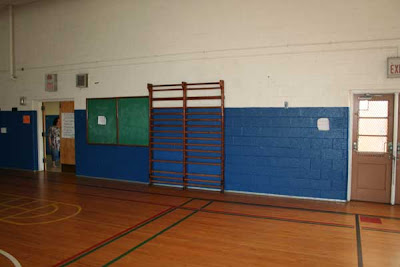
Photo taken June 11, 2007.
Subject: RE: Reinhardt memories
Author: Don HancockDate: 5/19/2007 8:04 pm
I would have loved to have seen those two. In my earlier message, I mentioned Janie Wilson’s finger snap (I use her first name because I don’t remember if she was a Miss or a Mrs.). I really think she preferred to use a triple meter fanfare motif—SNAP, SNAP, SNAP—which reverberated through the auditorium space and jarred our childhood brains to attention. It’s a mystery how she so effortlessly was able to condition so many thousands of little minds that went through that school. Is it my imagination that she also pinched children who were bad?
Subject: RE: Reinhardt memories
Author: Lynne Barber DavisDate: 5/19/2007 10:39 pm
Indeed she did pinch. I used to be one of the privileged few who were couriers between Miss Wilson, Miss Moore, and Mrs. Keeler. It always amused me to no end to see that Miss Wilson called Mrs. Keeler "Tootsie".
Date: 5/15/2007 11:20 pm
Since the reunion, Steve, Shari and I have been exchanging many emails with memories about going to Reinhardt, Gaston and BA. I thought I would share this one with a larger group.
Larry was a friend of mine, especially in the second or third grade. I visited his home one time; he lived over near the Catholic school, which was out of our district. His mother worked in the school cafeteria, and she likely got permission for his transfer so she could take him with her to work. I saw Larry’s picture in the 1967 annual and I think he was the only boy who had stuck with his crew cut and butch wax; I admire him for that. Some of the dumb girls pestered me to stop wearing my hair like that a year or so earlier.
At Reinhardt, I followed my older brother’s style of having a big waved over front and combed back sides—I’m sure there are better hairdressing terms for that Elvis style. Each August, when our moms surveyed our worn out, too small clothes, they would pack us off for a new set of Lee jeans, a little long but rolled up to allow some growing room, some high top basketball shoes [made of canvas and rubber, not petroleum-made products], or sometimes some Hardys leathers, possibly with taps on the heels.
Larry had an insider’s view of the Reinhardt cafeteria. Those of us who spent seven years there grew to love it. My mother was not a nurturing box lunch maker and most years I bought my lunch everyday. I always had a second and third trip to the hot roll with butter and ice cream counter. My favorite on the weekly menu was a Mexican dish—I think enchilada pie with chips.
In addition to cafeteria workers, we had janitors, who wore dark uniforms and hung out much of the day in a little basement where they had a machine to clean the chalk from the erasers.

Reinhardt janitor room had entrances from right of
stage and also from outside back of auditorium.
We children were organized for other ancillary support duties. One year, I arrived early each day to be on the U.S. and Texas flag raising team. I had learned all about flags because each morning as a class we recited the Pledge of Allegiance and Pledge to the Texas flag.

Circa 50s flagpole base at left of telephone pole. Photo
taken June 11, 2007.
Another year I was on the street patrol, and arrived early, rain or shine, and went to some special storage rooms in front of the auditorium where they stored the crossing flags, guard belts, yellow rain coats and galoshes.

Closet at rear of auditorium.
Taken June 11, 2007.
I never knew the Reinhardt physical plant did not include air-conditioning. If you’ve never had something, I guess you don’t miss it. I vaguely remember a special trip to the film room (I believe the only room in the school that was air conditioned and popular with teachers in late spring). Didn’t they have all kids, divided by sex, attend a special film show of sex education? Did we have to get our mother’s permission?
Schools in our Reinhardt era had to have many special facilities. Children are to be cultivated through activities such as gymnastics, dancing, singing, playing the flutophone, and making art. In Mrs. Keeler’s physical education classroom, we had a gym floor with long benches on three walls. Two days a week, Mrs. Keeler played square dance records and we honed our dancing skills—doing allemande lefts and allemande rights. Once a week or so, we had a special activity where the boys from one side of the room were allowed to rush across the room to select their female partner for the dance. And another day, the girls picked the boys... It sort of allowed the carrying out of a natural pecking order of childhood male-female attraction. On two other days a week, the tumbling mats came out, and we practiced our somersault, backward somersault, cartwheel, spiderwalk and flip. When we were bad, for things like breaking a no talking period, we were required to get down on our knees and place our nose on the stinky bench. This was similar to our bomb drill exercises, in case nuclear warheads came flying toward Reinhardt, when we were required to crouch in a fetal position in the hall in front of the lockers with our hands grasped behind our necks.

Circa 1960. Likely 6th or 7th grade class during tornado
drill. From Reinhardt Library. June 11, 2007.
Mrs. Keeler was outdone in my book by Miss Jones, the music teacher. What I would give to have the songbook from the third grade or so—great Southwest songs like Clementine and Celito Linda, and rounds like Dona Nobis Pacem. What were some of the others? And we all tested our musical instrument skills by being required to purchase and learn to play a flutophone.
In the art classes, what was the thin man’s name—Mr. Mattox?, we learned to use crayons, watercolors, tempura paints, did some ceramic work. I was on a team that created a sculptured model of the human eye and also followed the teacher’s instructions to create a three dimensional piece with geometrical placement of string that hung on the wall in front of the principal’s office for several months.
When it came to having a teacher who was in control, Janie Wilson had to take the prize. One snap of her fingers would bring the entire auditorium to total silence. Janie taught us to have school plays, chorus productions, speeches and much other neat stuff. I was honored to be in an evening production, where all the parents came, where a small group of boys, dressed like Elvis, with turtleneck shirts, sang “Watching All the Girls Go By.” All the moms and dads laughed and thought it was cute.
I was in a used bookstore recently and saw a teacher’s resource manual printed by Dallas ISD in the 50s that laid out their marvelous auditorium teaching curriculum. If the school systems could still recruit such cream-or-the-crop women like Janie Wilson, they should bring that back.
We started most days in the gymnasium. When you walked to school like I did, you tended to congregate on the blacktop or inside the gym if it was raining. Before school, with our backs to the wall, we would throw old volleyballs with cuts for handgrips, trying to smash someone at the other end of the gym, to pass the time before the first bell.
Gym classes were run in a very organized fashion. Boys from each class would line up on the floor behind their class captain and co-captain. The girls were lined up on the other side of the gym. Seems like most days we spent some time in calisthenics, Mr. Gerber leading the boys and Miss Moore the girls. We would do sit-ups, arm rolls—boy that really made your arms tired—push ups, leg lifts and other neat exercises.
One of the biggest surprises was a day in the sixth grade or so when Mr. Gerber had all us boys compete in a strength test. One of the activities was to climb the monkey bars. Steve, who had never been a great athlete, was the strongest boy in the class. He was to the top of those monkey bars in an instant. I could only get up to the fourth or fifth bar. So it goes that our childhood bodies distinguished and differentiated us once again.
Each year in the spring, we had the big outdoor field day where each class competed for ribbons—blue for first place, red for second place and gold for third place, in events such as standing broad jump, running broad jump, free throw and hundred yard dash.
If I were ever to go back to Reinhardt for a visit, I would want to go back on Carnival night. The PTA moms put on this big shindig in the fall, I think around Halloween. Each classroom was set up with fun activities like apple bobbing, cakewalk, and darts. They always had a scary room, I think in the art room, where you did scary, nasty thinks like put your hand into a hole and into something nasty like spaghetti. Seems like they also had a big bake sale so we went home with some great cakes and cookies.
We had fun on Valentines Day too. Everyone would make a sack and tape it to the wall. We would all post our Valentines, then read through the cards and messages in our sack. I one year received a very special valentine from Priscilla McClure. I think she must have been sweet on me.
We Reinhardt kids were fortunate to have many intelligent and dedicated men and women teachers and a really fine school system as well as many baby boom cohorts whom we can remember—45 or so years later--with fondness and generosity for each and every one.
Subject: RE: Reinhardt memories
Author: Julie Jenkins BowlingDate: 5/16/2007 1:16 pm
Do you remember the girl in Mr. Maddox room who hurt her leg on the window while cleaning and had to have Mr. Bolton the janitor carry her to the nurses office just before the end of the year? that was me. I remember Mrs. Ripley looked like Olive Oil, but back in thoses days we did not know who Olive Oil was...I remember all the memories you recanted and we lived a much easier time, we just did not realize it at the time. We had all that we needed and wanted at the time. We had more of our parents attention than children of today, times are sooo much more stressful for our kids' kids. Remembering the "good ole days" calms and soothes me. Thanks for reminding us to look back at that time of our lives.
Subject: RE: Reinhardt memories
Author: Steve WilenskyDate: 5/16/2007 9:25 pm
Why Don Hancock, you old...... Your reminiscing just ripped apart old long-buried scar tissue. You see, your eloquent use of the word "crap" just happened to catch my fancy in the 4th grade. I was very proud of the addition of a new word to my vocabulary and was equally proud to use when the opportunity presented itself. Well it seemed that one particular opportunity occurred in Mrs. Keeling's class ( I probably was frustrated that I could not execute the basic cartwheel for the jillionth time). Well, Mrs. Keeling was not as impressed with my word choice as I was. One of the unfortunate occurences of having your father precede you in the school you attend is that too many teachers know too much about you. Mrs. Keeling's response was not to reprimand on the spot. No, she knew of a much more dastardly punishment. She called home. When I arrived after school I received a generous double-header of a bar of soap which my sainted mother use to so disinfect my mouth, I blew bubbles until the 6th grade. The nightcap was reserved until my father returned home whereupon he practiced his forehand volley with his special paddle and my derriere masquerading as a tennis ball. Sadly, I was unable to return any of his shots. So thanks, Don, I was having a rather nice day.
Subject: RE: Reinhardt memories
Author: Steve WebbDate: 5/16/2007 10:08 pm
Well, since we're on Mrs. Keeling's case, did any of you have the "pleasure" of her sitting on your head while she had you place your nose on the "stinky" bench? That was one of her SPECIAL tortures if you continued to speak while on your knees, nose down! It only took one occassion of this sort to make a believer of me! Is it too late to call Child Protective Services?? Steve, your parents and mine must have read the same child-rearing books. If I got in trouble at school, I also got a double dose of punishment at home. Man, it was enough to keep us in line - usually...

Stephen Webb, age 58, with nose
to stinky bench. The old PE room
has other uses but a bench sits in hallway
in front of office, painted Ram's blue
over the original walnut finish.
Taken June 11, 2007.
Subject: RE: Reinhardt memories
Author: Don HancockDate: 5/16/2007 10:42 pm
Steve, when I taught kids new words like that, I also thought I always told them not to use them in front of the teacher. I may not have got through that unscathed. It seems that during that time I was asked by Mr Gerber to walk out for a little conference on one of the playing fields. He told me he had several reports of my bad behavior and I better straighten up or else. This man-to-man talk sounds infinitely milder than what you received from your parents.
Subject: RE: Reinhardt memories
Author: Steve BeeneDate: 5/19/2007 3:42 am
Boy have you brought back the memories...and I do remember climbing up the monkey bars.... What really was a hoot was years later when Webb and several others of us all got season tickets to the Opera with Ms Wilson and Ms Moore. It is hard to go out for drinks with someone who could make you freeze simply by pointing their finger at you.....

Photo taken June 11, 2007.
Subject: RE: Reinhardt memories
Author: Don HancockDate: 5/19/2007 8:04 pm
I would have loved to have seen those two. In my earlier message, I mentioned Janie Wilson’s finger snap (I use her first name because I don’t remember if she was a Miss or a Mrs.). I really think she preferred to use a triple meter fanfare motif—SNAP, SNAP, SNAP—which reverberated through the auditorium space and jarred our childhood brains to attention. It’s a mystery how she so effortlessly was able to condition so many thousands of little minds that went through that school. Is it my imagination that she also pinched children who were bad?
Subject: RE: Reinhardt memories
Author: Lynne Barber DavisDate: 5/19/2007 10:39 pm
Indeed she did pinch. I used to be one of the privileged few who were couriers between Miss Wilson, Miss Moore, and Mrs. Keeler. It always amused me to no end to see that Miss Wilson called Mrs. Keeler "Tootsie".
Subscribe to:
Posts (Atom)